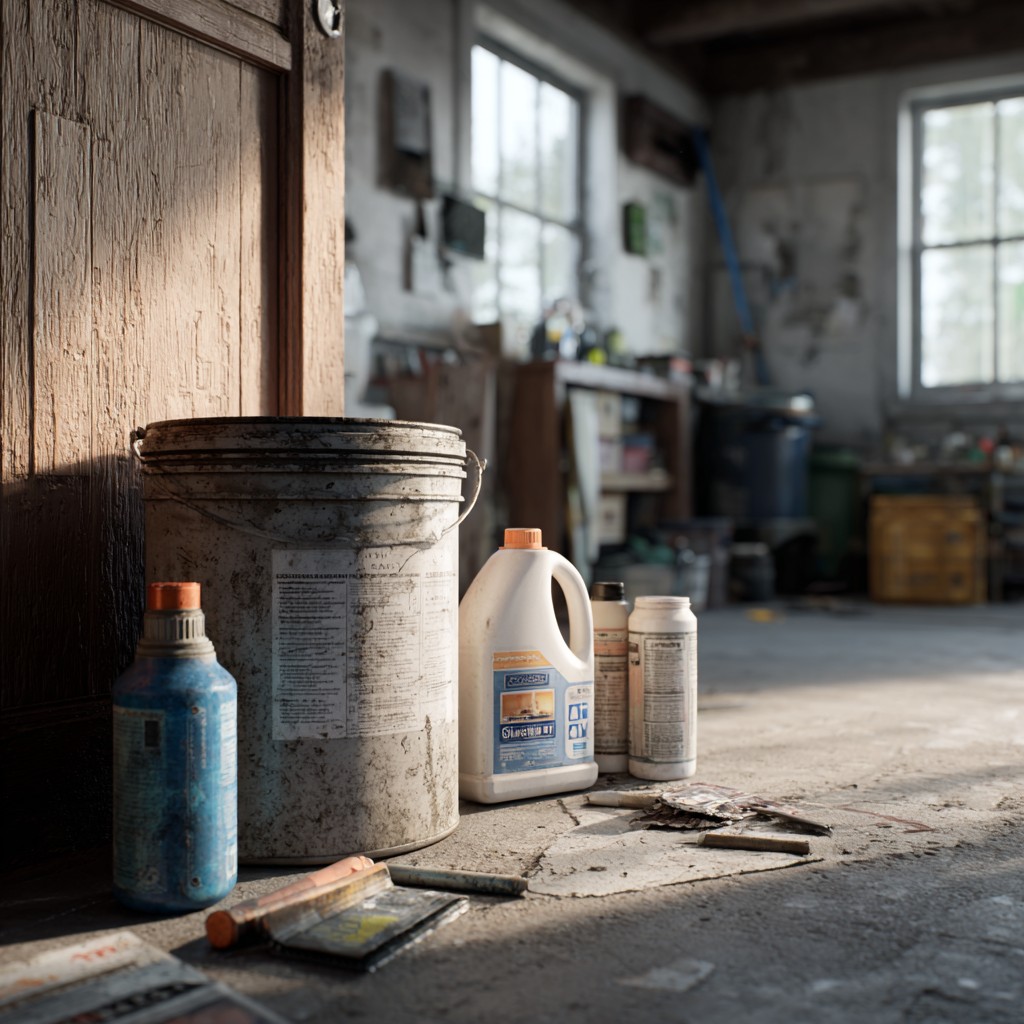
Open the cupboard under most London kitchen sinks and you will find the beginnings of a hazardous waste inventory. A half-empty bottle of bleach, a container of drain cleaner, a can of spray paint left over from a decorating job two years ago. Move to the garage or the garden shed and the picture typically expands – old motor oil, a rusting tin of wood preservative, a bag of lawn pesticide with a torn label, a collection of dead batteries in a margarine tub. Most homeowners give the disposal of these items little thought beyond a vague awareness that they probably should not go in the bin. That instinct is correct, and the legal and environmental reasons behind it are more substantial than most people realise. This guide covers the most common categories of hazardous household waste encountered by London homeowners, what the law requires, and where the legitimate disposal routes actually are.
What Makes Household Waste Hazardous – and Why the Category Matters
The legal definition of hazardous waste in the UK is grounded in the specific properties of the materials involved rather than their origin or volume. A substance is classified as hazardous if it is toxic, corrosive, flammable, reactive, carcinogenic, or ecotoxic – properties that make it capable of causing harm to human health or the environment if it enters the wrong place in the wrong form.
Household hazardous waste sits at an unusual intersection in the regulatory framework. The volumes produced by any single home are small. The aggregate volume produced by London’s four million or so households is very large indeed, and the cumulative effect of those materials being incorrectly disposed of – through general waste bins, kitchen drains, or garden disposal – is proportionally significant. Heavy metals leaching into groundwater, flammable liquids in waste trucks creating fire risk, pharmaceutical compounds disrupting aquatic ecosystems – these are not theoretical hazards constructed by regulators for the sake of caution. They are documented outcomes of routine incorrect disposal, occurring at scale.
Your Legal Obligations as a Homeowner
The Duty of Care framework under the Environmental Protection Act 1990 applies to anyone who produces, handles, or transfers waste – including domestic waste producers in cases where the material involved is hazardous. In practice, prosecution of individual homeowners for incorrect disposal of small quantities of household hazardous waste is rare, but the obligation exists and the risks – to others and to the environment – are real regardless of whether enforcement follows.
More practically relevant is the liability that attaches to passing hazardous waste to an unauthorised carrier. If you hand a box of old paint tins or motor oil to a clearance operative who is not licensed to handle hazardous materials, and that material is subsequently fly-tipped or disposed of illegally, the paper trail can lead back to you. Correct disposal through the channels described in this article removes that exposure entirely.
Paint – The Most Common and Most Misunderstood
Paint is the hazardous household material that Londoners are most likely to have in quantity, and the one about which the most confusion exists regarding correct disposal. The first and most important distinction is between water-based and solvent-based paint, because they are treated differently.
Water-based paints – which include most modern emulsions used for interior walls and ceilings – are not classified as hazardous waste once fully dried. Small quantities of dried water-based paint can go into general waste. The correct approach for leftover liquid water-based paint is to leave the lid off and allow it to dry completely before disposal – a process that can be accelerated by adding an absorbent material such as sand or cat litter for larger volumes.
Solvent-based paints – gloss, satinwood, exterior paints, and many specialist coatings – are a different matter. These contain volatile organic compounds and are classified as hazardous in liquid form. They cannot go into general waste, cannot be poured down drains, and cannot be tipped onto soil or composted. The correct route is a Household Waste Recycling Centre with a dedicated hazardous waste stream, or a specialist paint recycling scheme. Several community paint reuse organisations operate in London, accepting usable leftover paint for redistribution to community projects – a disposal route that extends the life of the product rather than simply treating it as waste.
Aerosol paint cans present an additional consideration. Even when apparently empty, aerosol cans may contain residual propellant and should be taken to a recycling centre rather than placed in general waste where pressurised containers create handling risks.
Batteries – Small Items, Consequences That Are Not
The humble battery sits at an interesting point in public awareness of waste disposal. Most Londoners are broadly aware that batteries should not go in general waste. Fewer know why in specific terms, and fewer still dispose of them correctly with any consistency.
The environmental case rests primarily on the materials involved. Alkaline batteries contain manganese and zinc. Lithium batteries – found in phones, laptops, tablets, and a growing range of small electronics – contain lithium salts and, in some configurations, cobalt. Lead-acid batteries, used in vehicles and some backup power systems, contain lead and sulphuric acid. When these materials reach landfill, they degrade over time and release their constituent compounds into the surrounding environment. When lithium batteries are damaged or subjected to pressure – as can happen in compaction vehicles – they present a fire and explosion risk that is a documented cause of waste facility incidents.
Battery collection points are the most accessible disposal infrastructure in London for this category of waste. Supermarkets, DIY stores, electronics retailers, libraries, and council offices across the capital operate collection boxes for household batteries – small, cylindrical AA, AAA, C, D, and 9V cells, as well as the flat button batteries found in watches and hearing aids. Vehicle batteries require separate handling and are accepted at Household Waste Recycling Centres. Laptop and phone batteries, as part of the devices that contain them, fall under WEEE regulations and should be disposed of through the WEEE channels covered in an earlier article in this series.
Medication – A Disposal Problem Hiding in Plain Sight
Old, expired, or unwanted medication is one of the most consistently incorrectly disposed of hazardous waste streams in London households – and one of the least discussed. The default behaviour for most people is either to flush medication down the toilet or to place it in general household waste. Both routes create environmental problems that are well evidenced in the research literature.
Pharmaceutical compounds that enter the sewage system are not fully removed by standard wastewater treatment processes. Synthetic oestrogens from contraceptive pills, antibiotics, antidepressants, and a range of other active compounds have been detected in river systems across the UK, with documented effects on aquatic organisms. London’s drainage infrastructure, serving one of the most densely populated urban areas in Europe, is a significant contributor to this load.
The correct disposal route for unwanted medication in London is straightforward and involves no cost or complexity: return it to any pharmacy. All registered pharmacies in the UK are required to accept returned medication from the public free of charge, regardless of whether you are a customer of that pharmacy. The returned medication is collected and incinerated through a licensed high-temperature process that destroys the active compounds. Sharps – needles, lancets, and syringes used at home – require separate collection through a sharps disposal scheme, which can be arranged through your GP surgery or local pharmacy.
Other Hazardous Items Commonly Found in London Homes
Beyond the three headline categories, several other materials found routinely in London homes require handling that differs from standard waste disposal.
Motor oil and other automotive fluids – brake fluid, antifreeze, transmission fluid – are toxic and persistent in the environment. They should never be poured down drains or onto soil and are accepted free of charge at all Household Waste Recycling Centres. Used oil can also be taken to some garages and automotive retailers who operate collection schemes.
Solvents and chemical cleaners, including white spirit, turpentine, acetone, and industrial degreasers kept for DIY purposes, are flammable and toxic. They go to the hazardous waste stream at a Household Waste Recycling Centre. Partially full containers should be taken with their original labels intact wherever possible, as labelling assists with correct classification and handling.
Pesticides, herbicides, and fungicides – the residue of a season in the garden or a one-off treatment job – are ecotoxic and should not be diluted and poured onto soil or down drains. Again, the Household Waste Recycling Centre is the correct destination. Fluorescent tubes and compact fluorescent light bulbs contain mercury and require separate collection from general waste – most large DIY retailers and some councils accept them.
Where to Take It – London’s Disposal Infrastructure for Hazardous Household Waste
The primary disposal infrastructure for hazardous household waste in London is the network of Household Waste Recycling Centres, all of which are required to operate a dedicated hazardous waste stream alongside their general recycling facilities. Every London borough provides at least one, and the service is free for residents. Opening hours vary by borough and site, and it is worth checking in advance whether there are restrictions on the volume or type of hazardous material a given site will accept on any single visit.
Some boroughs supplement their HWRC provision with periodic hazardous waste collection events or mobile collection points – arrangements that reduce the travel burden for residents without easy access to a fixed site. Details of these are published through borough council websites and are worth monitoring if you have a backlog of hazardous items accumulating.
For the materials with dedicated non-council routes – medication through pharmacies, small batteries through retail collection points, paint through community reuse schemes – those options are often more convenient than a trip to a recycling centre and should be considered the default rather than the fallback. The infrastructure for correct disposal of hazardous household waste in London is more accessible than its low usage rates suggest. In most cases, doing the right thing requires less effort than the uncertainty around what the right thing is.